
Equality, diversity, equity, accessibility, acceptance, inclusion and belonging - what does it all mean?
In the online world, I’m noticing a louder and louder call to reform the world so it’s more fair and just for all. These conversations are especially prominent in neurodivergent spaces or discussions of disability. People have been using various words to describe this ideal new world, the most recurring ones being “equality”, “diversity”, “equity”, “accessibility”, “acceptance”, “inclusion” and “belonging”. With these words being used interchangably by many, one may assume that they’re synonymus. However, that’s not quite the case! So let’s explore the similarities and differences between these terms so we know which ones to use when describing our dreams.
Dictionary Definitions
First of all, how does the English dictionary define these concepts? According to the Merriam-Webster dictionary, their definitions are:
- Equality - the quality or state of being equal (like for each member of a group, class, or society)
- Diversity - the state or practice of including people of different races, cultures, etc. in a group or organization
- Equity - fairness or justice in the way people are treated - often, specifically : freedom from disparities in the way people of different races, genders, etc. are treated
- Accessibility - the quality or state of being accessible (easily used or accessed by people with disabilities : adapted for use by people with disabilities)
- Acceptance - the act of accepting something or someone : the fact of being accepted
- Inclusion - the act or practice of including and accommodating people who have historically been excluded (as because of their race, gender, sexuality, or ability)
- Belonging - close or intimate relationship
Okay, so we have a solid starting point here! Looking at the list, I can see some similarities and differences. Equality, diversity, equity, and accessibility are all states of being. Acceptance and inclusion are both acts. Belonging and acceptance are both about the bonds between people. Diversity and inclusion are both practices.
But now there’s some new questions that need addressing. What makes equality different from equity? How does diversity differ from inclusion? And if belonging is just a “close or intimate relationship”, how does it belong on this list?
Let’s keep searching. Maybe taking a closer look these concepts will give us some answers.
Diving Deeper
Thanks to Google and the abundant resources on the Web, I was able to find more thorough explanations for each of our listed concepts!
I’ll start with equality versus equity. In their article “Enhancing Inclusion, Diversity, Equity, and Accessibility”, the University of Southern Queensland explains, “equality generally means treating people the same way, to give everyone equal access to opportunities and benefits in society”. Equity, on the other hand, is summarized as “treating some people differently, taking into consideration some people’s particular needs and situations”. So based on this information, we can conclude that equality means regarding all individuals as exactly the same and thus providing them all with identical opportunities, resources, and materials needed for survival. Conversely, equity recognizes that individuals are separate from one another, and thus may need more, less or different resources and supports than others. This distinction allows people to be given what they actually need for survival rather than what is assumed they need based on the merits of equality. To put it simply, equality sees everyone as the same and gives them all the exact same amount of resources and other needs. Equity realizes that different people have different needs, so it gives based on the individual’s need rather than using even distribution. With equality, everyone gets the same amount, but some may find it’s too much, not enough, or otherwise not right. Equity means everyone gets the exact amount they need.
Now let’s look at diversity versus inclusion. From the article “Key Terms and Definitions” on their Division of Student Services page, the University of Nevada, Reno (UNR) defines diversity as “The traits and characteristics that make people unique, including the dimensions of race, ethnicity, gender, sexual orientation, socio-economic status, age, neurodiversity, physical abilities, religious beliefs or other ideologies”. Meanwhile, the University of New Hampshire’s (UNH) “Relevant Terminology” article on their “Community, Belonging, Access and Inclusion” page explains inclusion as, “The ongoing, iterative, and constructive process of creating an environment in which an individual or group is welcomed, respected, supported and valued as a fully participating member”. UNH’s article expands on this with “While diversity is an important aspect of inclusion, diversity alone is not indicative of an inclusive environment. Inclusion is an active and intentional process of reflection, change, and improvement towards creating a space where all individuals can authentically be themselves, be accepted for who they are, and feel a sense of belonging as a result”. From what we’ve gathered, we’re now able to deduce that though diversity is an integral part of inclusion, the two concepts are not entirely the same. Diversity, from the Merriam-Webster Dictionary and UNR’s definitions, sums up all of the distinct characteristics that shape a person’s identity into one term, recognizing that no two individuals will be exactly the same, and strives to include them. Inclusion, though, is the act of putting diversity into practice and expanding on it by ensuring every presence is acknowledged, respected, heard, valued, and comfortable.
And finally, belonging. UNR’s article interprets belonging as “A sense of being secure, recognized, affirmed and accepted equally such that full participation is possible as one’s whole self”. By combining this definition with the Merriam-Webster entry, we can now say that belonging is when you form close, intimate relationships with people based on feeling safe, recognized, accepted, and heard enough to be your most authentic self.
This is a lot of information to take in at once! Let’s use a metaphor to break down all we’ve learned.
To Make It Simple
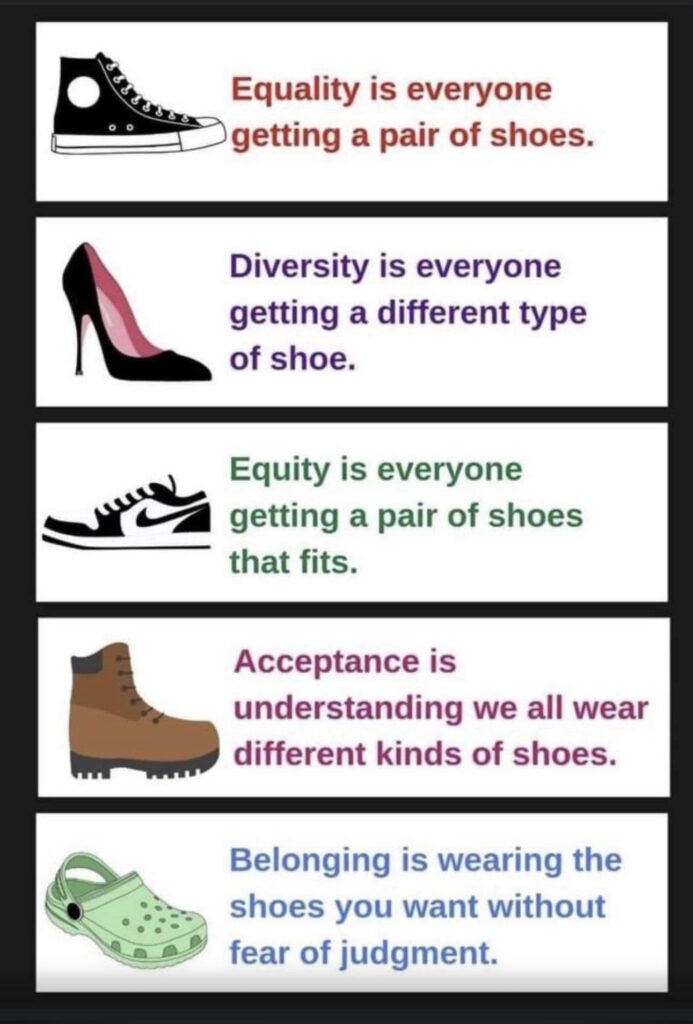
For the visually impaired, this graphic is white boxes against a black background, each with an image of a different kind of shoe and some text. The text boxes read:
“Equality is everyone getting a pair of shoes.”
“Diversity is everyone getting a different type of shoes.”
“Equity is everyone getting a pair of shoes that fits.”
“Acceptance is understanding we all wear different kinds of shoes.”
“Belonging is wearing the shoes you want without fear of judgment.”
And then I would add:
“Accessibility is people with disabilities getting shoes that are comfortable for them and support their needs.”
“Inclusion is creating a space where everyone can wear different types of shoes comfortably and without judgment.”
Now that we have an understanding, let’s wrap up by looking at some real life examples of these concepts in action.
In Practice
How do equality, diversity, equity, accessibility, acceptance, inclusion, and belonging look in the real world? Here’s some examples:
- Equality - The website Helpful Professor lists women’s suffrage, The Civil Rights Act of 1964, and the Americans with Disabilities Act (ADA) in their article “25 Equality Examples”.
- Diversity - Helpful Professor’s article “15 Diversity Examples” explains, “We’ll see that many films and television shows are making a concerted effort to ensure that people of a range of races are depicted in a range of roles. This includes ensuring people of color are depicted as protagonists, which can have the effect of helping young people of color see strong role models they can look up to”.
- Equity - The Annie E. Casey Foundation (AECF) shared a story of one of their partners in their article “What’s the Difference Between Equity and Equality?”. They write, “During the height of the COVID-19 pandemic, a community partner organization — which was a member of the Foundation’s Results Count hub program — considered adopting a vaccine promotion strategy that would direct local residents to CVS pharmacies to receive inoculations. But since the goal was to provide positive health outcomes for all residents, a closer look at this strategy revealed its flaws. There were no CVS pharmacies located in predominantly Black and Latino neighborhoods, and transportation barriers would make it nearly impossible for many of these residents to access the vaccines. With equity in mind, the strategy was completely reimagined, and community partners collaborated on the mobile distribution of vaccines throughout areas with Black and Latino residents”.
- Accessibility - Many buildings in the US have ramps and elevators to aid wheelchair users and those with other physical handicaps in accessing the building and its separate floors.
- Acceptance - Autism Housing Network has established Trailhead Community, where adults with intellectual and developmental disabilities live alongside neurotypicals who have intentionally chosen to participate in neurodiverse community living.
- Inclusion - In her article “Creating ‘Moments of Inclusion’ In Your Daily Life”, Medium writer Sarah Cordivano shares this idea, “A friend recently told me the story of his lead buying a cake for his 2 year work anniversary celebration. Before buying the cake, the lead asked my friend whether he drank alcohol. The lead wanted to buy a cake that my friend was able to eat. This was a small consideration but it could be the single action that ensures someone can actually enjoy their own celebration cake. If you there is alcohol in a cake or dish you brought to the office to share, it’s a good idea to properly label it so people know and can avoid it if they don’t drink”.
- Belonging - Greater Good Science Center outlined a kind of belonging that comes from “community of identity” in their Greater Good Magazine article “The Six Points of Connection We All Need”. They write, “Belonging to a community with a shared identity is one of the most effective ways to foster deep, meaningful connections. People feel most comfortable, understood, and supported in groups where they share core aspects of their identity, such as ethnicity, culture, gender, or experiences. A shared identity fosters deeper trust, emotional safety, and, crucially, a deep sense of belonging…Communities form around cultural associations such as lesbian, gay, bisexual, transgender, and queer (LGBTQ+) networks, faith groups, professional affinity groups, or alumni chapters. People connect through shared narratives and experiences. Simply witnessing others who “look like me, live like me” and share values creates a profound sense of emotional connection. A civil society is a web of these groups that support their members but also ideally bridge people across differences”.
So now, not only can we define equality, equity, diversity, accessibility, acceptance, inclusion and belonging, we can also explain the differences between them and give examples!
I hope this article has given you a deeper appreciation for these ideals and their impact on our world. Thank you so much for reading my work today. See you next time, and remember to keep blooming!
Sources:
https://www.merriam-webster.com/dictionary/equality
https://www.merriam-webster.com/dictionary/equal
https://www.merriam-webster.com/dictionary/diversity
https://www.merriam-webster.com/dictionary/equity
https://www.merriam-webster.com/dictionary/accessibility
https://www.merriam-webster.com/dictionary/accessible
https://www.merriam-webster.com/dictionary/acceptance
https://www.merriam-webster.com/dictionary/inclusion
https://www.merriam-webster.com/dictionary/belonging
https://usq.pressbooks.pub/diversityandinclusionforoer/front-matter/definitions
https://www.unh.edu/community-inclusion/resource/relevant-terminology
https://www.unr.edu/student-services/diversity/definitions
https://www.facebook.com/groups/1406139906351001/posts/4001830793448553
25 Equality Examples
15 Diversity Examples
https://www.aecf.org/blog/equity-vs-equality
https://medium.com/sarah-cordivano/creating-moments-of-inclusion-in-your-daily-life-25687330373d
https://greatergood.berkeley.edu/article/item/the_six_points_of_connection_we_all_need
0 Comments